
The Way
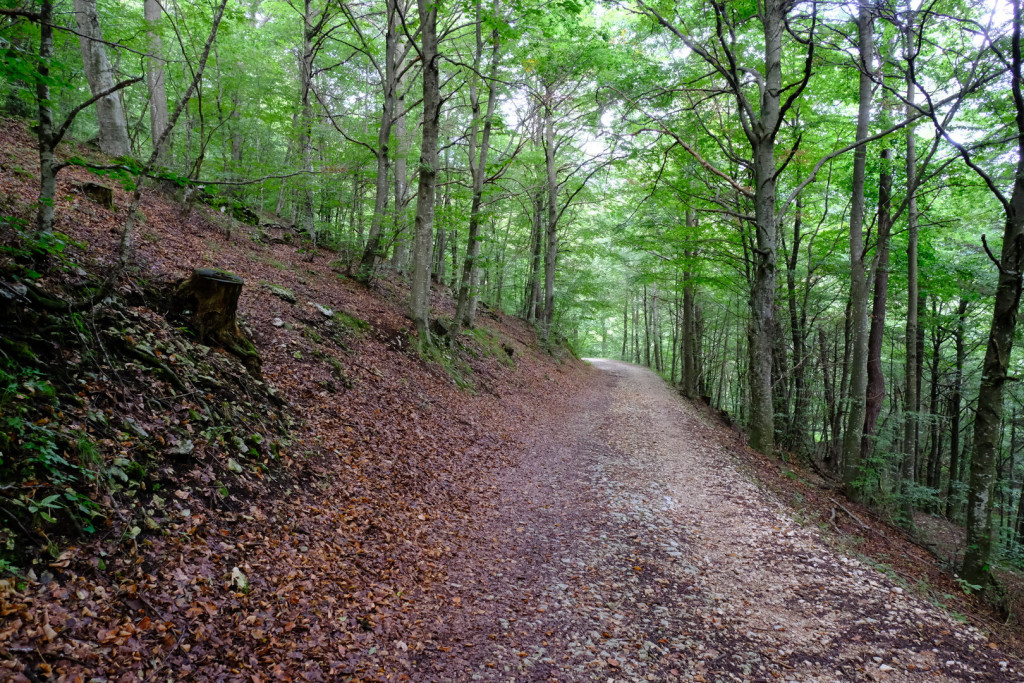
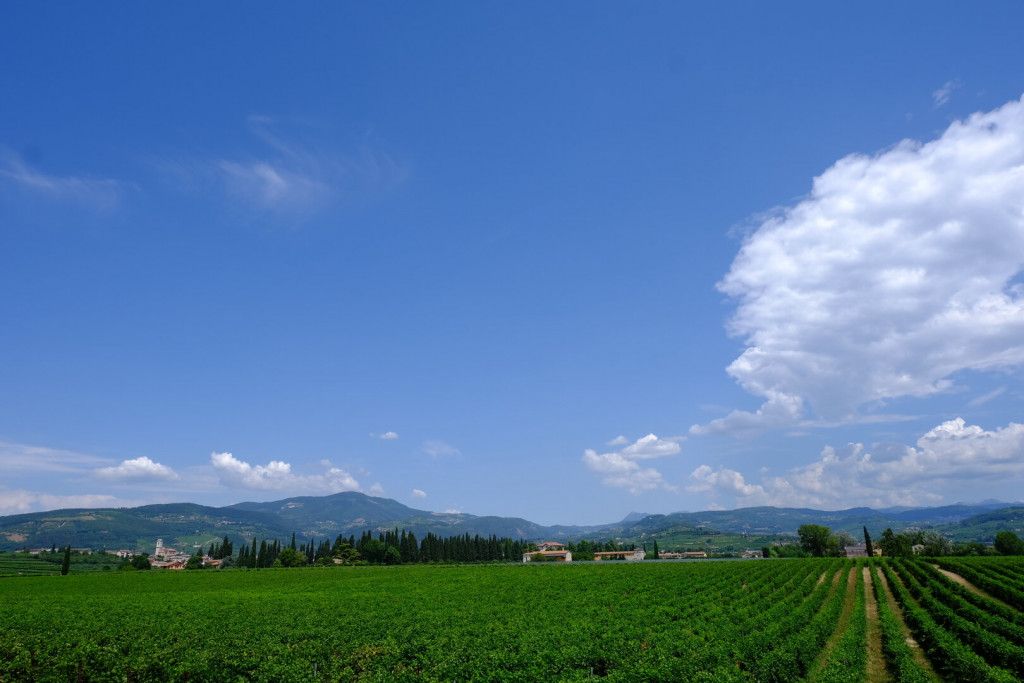
The Cammino del Vino e della Pietra crosses a vast and ever-changing landscape, from the hills of Valpolicella to the high pastures of Lessinia, before descending once again into the valley. We are in the northwestern part of the Province of Verona, between the Adige River and the limestone peaks of the Lessini Mountains—two distinct landscapes bound together by centuries of shared history and culture.
Walking here means tuning in to an environment that changes with every step: neat rows of vineyards give way to woods, stone hamlets, open pastures, and rocky outcrops. There is no sharp boundary between Valpolicella and Lessinia—and that is the beauty of it: you pass from one to the other almost without noticing, fully immersed in a living landscape rich in history and human presence.
Valpolicella is world-renowned for its great red wines, especially Amarone, but proudly displays traces of a much older past: from Paleolithic archaeological sites to Roman remains like the Temple of Minerva in Marano and the Villa of Mosaics in Negrar. Medieval churches, large parish churches, small village chapels, stone crosses, and votive shrines speak of centuries of faith and tradition. In more recent centuries, the valley has been enriched by numerous Venetian villas, surrounded by gardens, parks, tree-lined avenues, and stone walls that shape a truly unique hilly landscape.
As you climb into Lessinia, the landscape opens up and takes on a new character. You enter the Lessinia Regional Nature Park, a protected area filled with geological, natural, and historical marvels: from the spectacular Molina Waterfalls to the monumental Ponte di Veja, one of the largest natural rock bridges in Europe. Here you’ll encounter stone quarries—some still active—and ancient mountain settlements where stone has been shaped over the centuries to build roofs, fountains, and dry-stone walls. The high pastures offer wide open spaces, ideal for summer grazing, and breathtaking views that stretch into the distance.
On clear days, from these heights you can see the Brenta Dolomites, the Monte Baldo range, the Adige Valley, the Veronese plain, and even the Apennines on the horizon. These are vast, silent panoramas that reward the effort of walking and invite contemplation.
Human presence has also left a deep mark. In Lessinia, you can still sense the influence of the Cimbri, a Germanic people who brought their language, architecture, and traditions. The mountains were lived with ingenuity: pastures, mills, barns, fountains, and stone paths speak of a hard life, deeply rooted in respect for the land.
Today, those who walk this route do so out of passion, a desire for exploration, or the simple joy of walking slowly. And it is precisely that slow pace that allows one to perceive the signs of past and present, in a landscape that changes with the seasons—keeping memory alive while sketching out a future in constant transformation.
The Cammino del Vino e della Pietra does not yet have physical signage along the route.
We are in the initial phase of the project and, in order to avoid invasive or unauthorised interventions on the territory, navigation is carried out using the official GPX tracks and the maps available on our website.
Each stage is described in detail and accompanied by photographs and useful information.
We therefore invite all walkers to download the GPX files in advance and to carefully consult the route descriptions.
Map and Route Info (Without Variants)
- Total distance: 158 km
- Minimum elevation: 99 m
- Maximum elevation: 1,750 m
- Total ascent: 6,100 m
- Total descent: 6,100 m


Why wine?
For more than two thousand five hundred years these hills have been a land of vines and wine. The origins are lost in time: the Etruscans may have introduced viticulture, but it is certain that the Romans regarded it as highly valuable. At the beginning of the 5th century, at the end of the empire, Cassiodorus, secretary to the Ostrogothic king Theoderic, wrote a letter to the people of Verona praising a dense red wine, and also a white one, almost something to be eaten, obtained by letting the grapes dry before pressing. A description that anticipates by centuries the techniques used for Amarone.
During the Middle Ages, Valpolicella wine supplied the many lively inns of Verona. Meanwhile, in the countryside, nobles and landowners cultivated vines for their own use, often around Venetian villas, turning wine into a precious good and a symbol of prestige.
A major turning point came in 1969 with the creation of the Valpolicella DOC specification, which strictly defined the production area, grape varieties and production methods. Along the entire hilly belt of Verona, from Negrar almost to Soave, only a few denominations can be produced today:
Valpolicella Classico and Superiore, dry and fresh red wines,
Valpolicella Classico (in the historical area),
Valpolicella Superiore,
Amarone della Valpolicella DOCG, a powerful red made from dried grapes,
Recioto della Valpolicella DOCG, its sweet and ancient counterpart,
Valpolicella Ripasso DOC, a wine “re-passed” over the pomace of Recioto or Amarone, inheriting their body and aromas.
The main grape varieties are Corvina (45 to 95 percent), Corvinone (up to 50 percent), Rondinella (5 to 30 percent) and other authorised red varieties from the Province of Verona (up to 25 percent).
The traditional training system is the Veronese pergola, with shoots arranged horizontally to form a sort of canopy. This structure protects the grapes from sun and humidity, encourages temperature variation and helps in selecting the best bunches, especially those intended for drying.
Walking through these vineyards means experiencing a tradition rooted in ancient history yet still very much alive today, season after season, harvest after harvest.
Why stone?
Walking along this route, it is impossible not to notice how present stone is everywhere: in walls, roofs, doorways, paving, fountains and boundary markers. In Valpolicella and Lessinia, stone is not only part of the landscape but also a form of memory, culture and living material that has shaped villages and hamlets for centuries.
There are mainly two types of stone, both ancient in origin and of great value: Verona red marble, a limestone technically known as Rosso Ammonitico, and the Prun stone, or Scaglia Rossa Veronese, known for its natural layered structure in thin slabs.
Red marble was already being quarried in Roman times, especially in the area now known as Sant’Ambrogio di Valpolicella. From there it was transported along the Adige River to Verona, where it was used to build monumental structures such as the Arena, the Roman Theatre and the ancient city gates. From Verona it also travelled to other cities of the Po Valley, and many columns, capitals and sculptures in Romanesque cathedrals of northern Italy are carved from this strong and striking material.
Around this marble, over the centuries, an entire world of stonecutters, sculptors and architects developed, exporting their craft even overseas and leaving an imprint that extends far beyond the borders of the region.
Prun stone, on the other hand, is more modest but no less fascinating. It occurs naturally in thin overlapping slabs, about seventy layers separated by a very thin line of clay. This structure makes it ideal for roofs, floors and masonry. Since antiquity it has been used in houses, farm buildings and property boundaries. The Villa of the Mosaics in Negrar, dating to the 3rd century AD, still preserves traces of it in its original floors.
Until the mid-twentieth century, stone was quarried in underground galleries. The first quarrying area was between San Giorgio and Monte Solane, and later the area just above Prun became established. Today it is quarried in higher areas where the slabs lie close to the surface.
The availability of slab stone gave rise to a distinctive architecture, that of the stone villages, which deserves to be better known.
Walking Passport
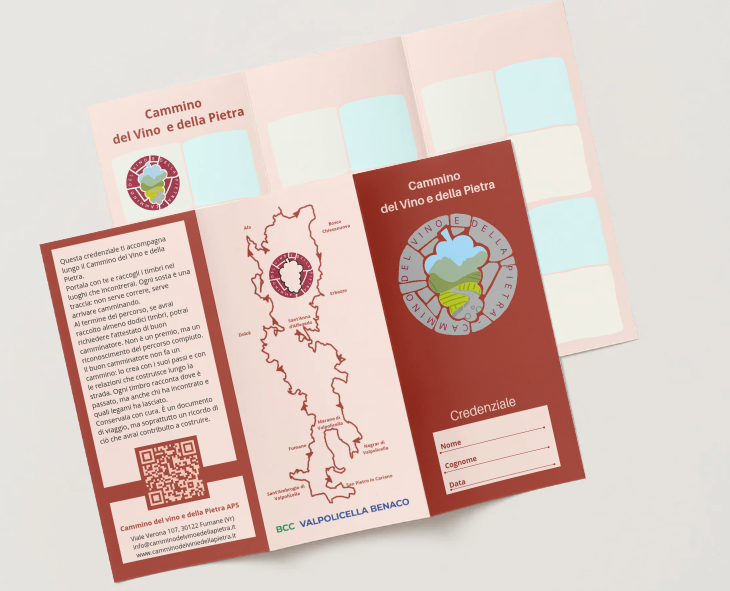
The Walker’s Credential is your travel companion: a small personal document to be stamped along the route, recording the stages you have completed and preserving the memory of your journey. You can collect it for free at the designated distribution points, or download it online as a PDF and print it at home. During the walk, ask for a stamp at participating locations that display the Cammino’s logo, such as guesthouses, shops, cafés, cooperatives and local associations.
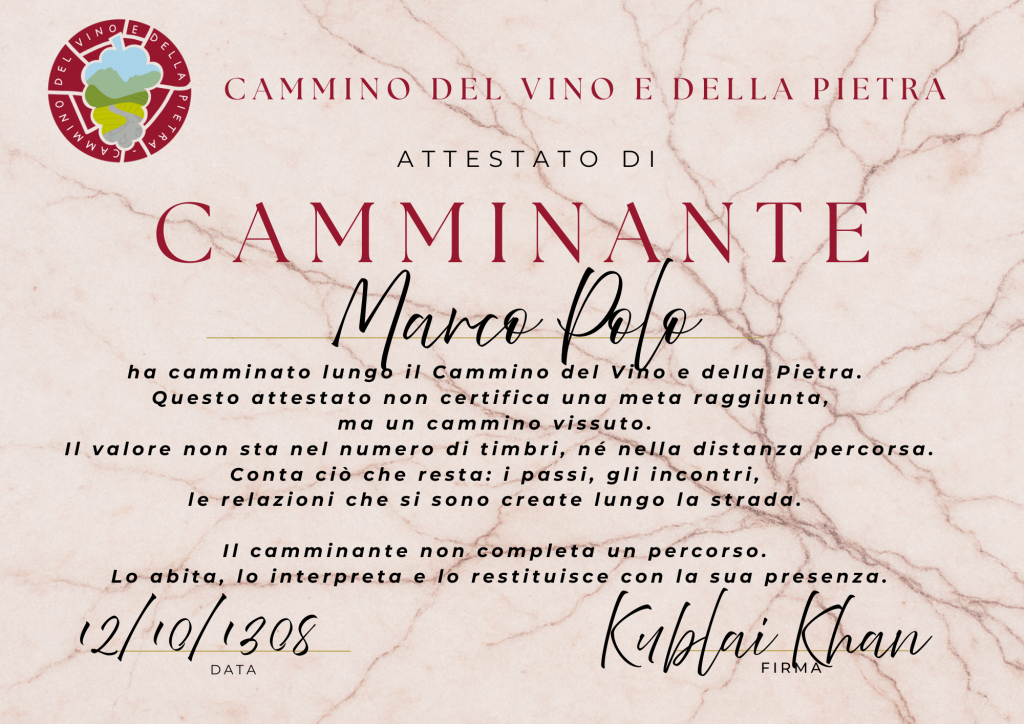
If you collect at least 10 stamps, you can receive upon arrival a “Walker’s Certificate” to mark your passage along the Cammino del Vino e della Pietra.
The credential is not mandatory, but it is a useful tool for enhancing the route: through it, we help the territory grow and improve its hospitality for future walkers.
Head Office of the Cammino del Vino e della Pietra
(for information and membership)
Viale Verona 107 – Fumane (VR)
Important notice
The Cammino’s head office is currently located in Fumane, about two kilometres from the official starting point of the route. It does not coincide with the beginning of the first stage. The office is not the starting point of the walks, but the administrative and information centre of the Association.
Pilgrim passports (credentials) can be collected in San Pietro in Cariano, unless already requested by email, at:
How to Get There by Private Transport
Take the Verona Nord exit and follow the SS12 towards Valpolicella. After about 12 km, you will reach a first roundabout: take the first exit. After passing a second roundabout, at the next one take the first exit again onto Via Mara. After about 100 meters, on the right, you will find IIS Calabrese-Levi.
Continue along the same road until you reach Piazza San Giuseppe, where a large free parking area is available.
From Lake Garda or Valdadige
Once you reach Domegliara, follow the signs for San Pietro in Cariano (towards Valpolicella) and continue to the town. Once there, follow the directions above to Piazza San Giuseppe.
Parking Areas
San Pietro in Cariano has numerous free parking areas, as shown on the map. The one in Piazza San Giuseppe (the starting and ending point of the route) is naturally recommended. There are also several free parking spaces along the streets throughout the town, but it is advised not to leave your car on Via Beethoven, where the weekly market takes place, or in the parking area on Via Barbassa, which is also used for markets.

Getting There by Public Transport
From Verona Porta Nuova (train station)
From the Verona Porta Nuova railway station, you can reach San Pietro in Cariano by bus no. 21 or bus 93, with many daily services. The bus is bound for Domegliara station and also stops in San Pietro in Cariano, in front of the pharmacy, after about one hour.Continue on foot and turn immediately left onto Via Roma, following it past Piazza Ara della Valle. Continuing along Via Roma, you will reach a small roundabout; turn right onto Via Molino and shortly after you will arrive at Piazza San Giuseppe.
From Domegliara train station
For those arriving by train in Domegliara, simply take a bus towards Verona and get off after about 20 minutes at the San Pietro in Cariano stop. Continue on foot and, after passing a roundabout, turn right onto Via Mara; following it to the end, you will reach Piazza San Giuseppe.
Why choose public transport?
We strongly encourage travelers to arrive by public transport whenever possible:
it’s the best way to enter the spirit of the Cammino, reduce your environmental impact, and begin the journey with awareness and a slower pace.
Always check updated schedules
Timetables may vary depending on the day: https://www.atv.verona.it/orari_linee_bus_extraurbani